The email communications you send out reflect your brand’s personality.
Whilst launching useful, communicative and visually appealing emails should be your top priority, it’s important to also focus on how you can tap into your recipient’s emotional side too.
One way in which this can be done is using humour. Not only can humour help make your campaign stand out amongst the many emails your recipients are inundated with every day, but humour can also help build an emotional connection with your audience.
However, there are do’s and don’ts when it comes to using humour. As with anything experimental, there’s a risk involved.
In this blog, we’re going to explore the best ways to add humour into your communications so the jokes land the right side up.
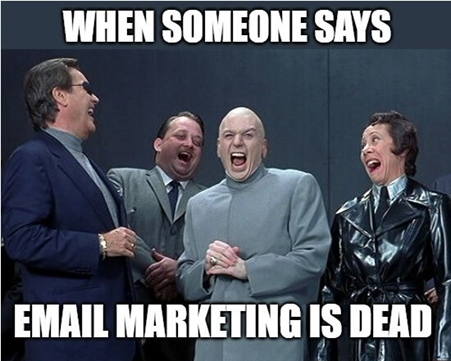
Why Use Humour?
Naturally, there are many reasons as to why using humour in email campaigns is a good idea, but the main points we’re going to focus on is the power it holds to build a strong emotional connection, shareability and how it helps make your campaigns stand out.
When laughing, the human body releases endorphins. This in turn boosts positive emotions with the entity which caused this release – the entity in this case being your email campaigns. Not only does this make your brand more memorable (and relatable), but it allows your recipients to build an emotional connection with your company. The benefit of this? Customer loyalty.
Hand in hand with customer loyalty comes the encouragement to share. Have a think about how often you’ve shared a funny video or image with friends. If you campaign is humorous, recipients are more likely to share it, getting your brand/communication further with no extra cost.
Humour can also break through the indifference of wordy and ‘normal’ emails by grabbing attention and hence making your campaign stand out. Recipients love brands who aren’t afraid to laugh at themselves and by doing so, you make your brand less robotic and more human (tying in nicely with my earlier point of building an emotional connection).
Do’s
In line with the theme of this blog, let’s start on the more positive side and explore the do’s of humour in email marketing:
- Funny Subject Lines
The first snippet a recipient sees of your email campaign is the subject line and it’s therefore arguably one of the best places to use humour. Use the subject line to say the opening line of a joke, with the answer being in the email. This sparks a sense of curiosity in the recipient who will in turn open your email to find the punchline. Open secured! Perhaps use the preheader text to entice your recipient further – eyes emoji anyone? - Use Puns
As mentioned in the previous point, jokes are a great way to entice recipients to open your emails – but so are puns! While some love them and others loathe them, a good pun is funny (and we all secretly know it). Tailor them to your industry niche and you’re onto a winner. For example, this is an ‘e-mazing’ blog post 😊 - Creative CTA’s
One great place to inject some personality into your email campaigns is your CTA’s or call-to-action buttons. Replace the tired “Read More” and “Click Here” with funnier phrases, perhaps using a recipient’s name or other personalisation fields. Who wouldn’t want to a click a button that reads “Gimme the goods” … We used ‘Bah Hambug and Unsubscribe here’ in a Christmas email once! - Inside Jokes
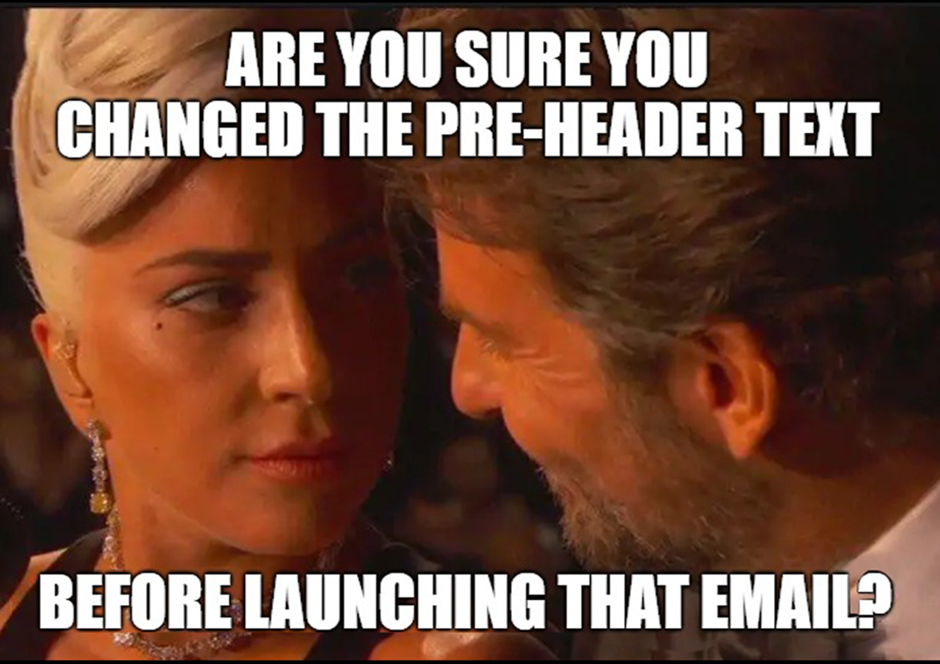
Like jokes with your friends, the funniest are the ones that only make sense to your group. In the same way, it’s important to tailor the jokes being made so that they relate to the audience/industry you’re emailing. Not only can this strengthen the relationship in this community but it can also create a sense of relatability. Perhaps consider taking a viral meme and adjusting it to fit your content. We made the one below Lada Gaga and Bradley Cooper at the Oscars in 2019, as we found people often omitted or forgot to change the preheader text.
- Welcome Emails
A great place to incorporate humour is in welcome emails. This can set the tone for your future communications and give your audience a sense of your brands personality. Not to mention it can get audiences excited to receive future campaigns. - Apology Emails
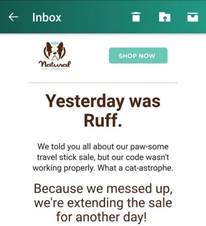
Depending on the nature and topic of an apology email (disclaimer alert!), these can also be a good environment to introduce some humour. These types of emails allow you to poke fun at your brand and to show that you are human, relatable and more than anything – willing to laugh at yourself. Just be sure to not downplay any issues that could cause frustration with your audience!
- Special Occasions
Who doesn’t enjoy some extra recognition on their birthday or anniversary? Communicating that you’re aware of these events shows you pay attention to your audience. Why not take the extra step by throwing humour into the mix, showing a more personable side to your brand.

- Product Feedback Requests
Naturally, you would always want your audience to be in a good mood before asking them to leave a review or write a recommendation. What better way to set this up then making them laugh first? Add humour into your feedback emails to set the tone and encourage recipients to leave positive feedback.
Check out an example of how we used humour in our Christmas campaign here.
Don’ts
Hopefully (if you didn’t skip the above section!) you’ll now have an idea of how and when to use humour in email marketing campaigns. However, it’s equally as important to know how and when to not use humour.
There is a fine line between being funny and unprofessional and you don’t want to end up on the wrong side of that line. We would strongly recommend against using humour in any of the following types of communications:
- Service emails where you’re making recipients aware of upcoming changes or disruptions.
- Sensitive data related emails such as password resets or transactional emails (receipts etc).
- Responses or reactions to serious global, industry or company news.
- Sensitive, informative communications such as price increase awareness emails or product recalls.
In all of the above, your audience would far more appreciate a more sincere and honest tone as opposed to you making light of a situation.
It also goes without saying that humour should never be used to target or offend any particular group of people. Pro tip – if you aren’t sure if a joke may be received as offensive, it’s probably best to leave it out.
While we encourage using snippets of humour, do keep in mind that recipients can get bored easily. Repeating the same kind of humour may put off audiences and result in them not engaging with your brand as often as they know what to expect. That being said, humour can be that breath of fresh air so long as you switch it up.
Play It Safe – A/B Test
If you are slowly starting to introduce humour into your emails, it may be worth playing it safe and doing a split test to see how a segment of your audience reacts first.
With Campaignmaster, you can create a split test with up to five versions meaning you can send multiple versions of the same email with each having a varying element; one could have a more serious tone and another with a humorous one.
If your humorous toned email receives a good response, you’ll know exactly what works and what should be included in your email recipe moving forward.
Crafting a funny and effective email campaign can be tricky, but we hope this blog has given you some food for thought.
Although we can’t pre-test your jokes, we can ensure many other aspects of your email campaign are working as intended to ensure your well thought out email lands in the inbox, ready to receive all the chuckles it deserves.
Please do get in touch at info@campaignmaster.co.uk with any questions you have and one of our friendly reps would be more than happy to help.
Alternatively, you can sign up for a demo here.